

Why Recurring Problems May Signal That a Couple Has Reached a Developmental Turning Point
James Tobin, Ph.D.
Couples often enter therapy because they have reached a conflict, distance, or impasse they can no longer resolve. The Inflection Model considers another possibility: that the presenting problem may reveal something beneath the conflict—a relationship whose established way of organizing intimacy no longer adequately fits the people the partners have become.
Key Points
- Couples often live with significant relationship difficulties for a considerable period before seeking couples therapy. By the time they arrive, the problem has usually survived numerous attempts at resolution.
- Every enduring relationship develops a relationship architecture—an often invisible organization of roles, assumptions, expectations, emotional habits, and mutually reinforced adaptations.
- Some qualities that initially create attraction and compatibility are psychologically interlocking: each partner’s way of adapting fits, supports, or stabilizes something in the other.
- Over time, a once-successful architecture may become increasingly rigid while the people within it continue to develop. I refer to this narrowing as Compression.
- Compression precedes inflection. As the gap widens between what the existing relationship can accommodate and what one or both partners now require, the relationship approaches an inflection point.
- Couples therapy can involve more than resolving the presenting disagreement. It can help partners recognize the relationship organization beneath the conflict and participate consciously in its reorganization.
- Mature intimacy may depend less upon preserving one successful form of relationship than upon remaining capable of reorganizing that relationship as both people continue to change.
The Problem Has Usually Been There for a While
There is a particular kind of argument that eventually begins to feel different from ordinary disagreement. It may concern parenting, money, sex, household responsibilities, extended family, work, or how much closeness each person wants. The subject itself may matter greatly. Yet after enough repetitions, both partners begin to recognize something strangely familiar. They already know the accusations that will be made, the explanations that will follow, the moment when one becomes more insistent and the other more distant, and the weary point at which the conversation will finally end without anything having been settled.
Couples rarely enter therapy the first time this happens. More commonly, the relationship has been trying to solve the difficulty on its own for some time. One partner raises the issue; the other promises change. They may read something, ask friends for advice, agree not to fight in front of the children, attempt a different division of responsibilities, schedule time away together, or temporarily decide the issue is not important enough to keep discussing. Things may improve for a while, and then some version of the old problem returns.
The popular couples-therapy literature has long repeated the claim that distressed couples wait approximately six years before seeking professional help. That figure should be treated cautiously. Doherty et al. (2021), in a study specifically examining the interval between serious relationship problems and entry into couples therapy, found an average delay of 2.68 years, with nearly two thirds of participants reporting that significant problems had been harming the relationship for two years or less before treatment. Other populations have shown longer intervals, suggesting that there is no single timetable for seeking help.
What appears clearer is that entering couples therapy is itself a process. Partners must first recognize that a relationship problem exists, then begin considering professional help, and eventually reach the point of entering treatment (Doss et al., 2003). Cost, scheduling, childcare, uncertainty about therapy, fear of difficult emotional work, and perhaps most importantly, one partner being ready before the other can all delay that process.
By the time a couple arrives in my office, the presenting dilemma is therefore usually not new. What may be new is the realization that the relationship’s familiar ways of restoring itself no longer work. One partner may say, “We’ve been fighting about this for years, but something has changed.” Another may say, “We always had problems, but we used to be able to get past them.” Sometimes the statement is quieter: “I don’t think we can keep doing this.”
Over years of clinical work, I have increasingly come to wonder whether some apparently irresolvable relationship dilemmas remain unresolved because they are being understood at the wrong level. Communication problems, attachment injuries, sexual disconnection, betrayal, and repetitive conflict all deserve serious attention, and contemporary couples therapy offers well-developed ways of addressing them (Johnson, 2019; Lebow & Snyder, 2022; Roddy et al., 2020). Yet sometimes the conflict itself is not the deepest phenomenon requiring explanation.
Sometimes the argument that cannot be solved is the place where something changing within the relationship as a whole has finally become visible. The couple arrives asking, understandably, How do we solve this problem? A different question may gradually become possible: Why has this particular problem become so difficult to solve in this particular relationship at this particular moment?
That question leads beneath the presenting dilemma and toward the psychological organization of the relationship itself.
The Relationship We Build Without Knowing We Are Building It
Long-term relationships acquire structure. Two people do not simply fall in love and then proceed through life as independent personalities occasionally interacting with one another. Through thousands of ordinary encounters, they gradually establish a way of being together. They discover how disagreement will be handled, how much vulnerability feels tolerable, who tends to take responsibility when something goes wrong, how affection is expressed, how decisions are made, how independence and closeness are negotiated, and what happens when one person needs something the other does not initially know how to provide.
This general idea has deep roots across several psychological traditions. Systems theory emphasized that couples and families create organized relational patterns that cannot be adequately understood by examining either person in isolation (Minuchin, 1974). Karney and Bradbury’s (1995) vulnerability-stress-adaptation model located relationship development in the continuing interplay among what partners bring into a relationship, the circumstances they encounter, and the adaptive processes through which they respond. Relational psychoanalysis similarly shifted attention from isolated psychological selves toward patterns of mutual influence through which each person’s experience becomes organized in relation to the other (Mitchell, 1988).
Most of this structure is never consciously designed. A particularly competent partner may begin handling the family’s practical affairs because doing so makes life easier for both people. Another may become the person who notices emotional tension first and initiates conversations about it. One becomes skilled at calming conflict; the other discovers that withdrawing temporarily prevents escalation. One anticipates what everyone needs, while the other comes to rely on that anticipation.
None of these arrangements is inherently problematic. Many express love, compatibility, generosity, and practical intelligence. Relationships could hardly survive if every aspect of emotional and practical life had to be renegotiated each morning. Over time, however, repeated solutions become expectations; expectations become assumptions; and assumptions acquire the quality of rules, although nobody remembers explicitly agreeing to them.
I have come to think of this underlying organization as relationship architecture.
Like the architecture of a house, relationship architecture is both enabling and constraining. A house creates rooms, passages, boundaries, openings, and places of gathering. Its structure makes certain forms of living possible while making others more difficult. Relationship architecture functions similarly. It provides continuity and psychological stability, but it also quietly influences what partners expect from one another, which emotions can be expressed comfortably, which roles feel natural, how conflict is interpreted, and what each person comes to believe is possible within the relationship.
The architecture is often most powerful precisely when nobody can see it.
The Strange Logic of Compatibility
The origins of this architecture begin before two people meet. Each of us enters adult relationships already having learned something about how to manage emotional life. We develop characteristic ways of handling dependency, disappointment, vulnerability, conflict, competence, autonomy, shame, longing, and uncertainty. Some of these ways of being are visible to us; others have become so familiar that we experience them simply as personality.
Attachment theory describes how repeated relational experience helps shape expectations concerning availability, dependence, closeness, and emotional security (Bowlby, 1988). Psychoanalytic approaches to couples have long been interested in a related question: why particular people experience one another as psychologically compelling. Dicks (1963, 1967), for example, explored unconscious relational fit in partner selection, while later object-relations and relational approaches emphasized the ways partners may evoke, carry, or stabilize aspects of one another’s psychological worlds (Scharff & Scharff, 1997).
A person who grew up in an unpredictable emotional environment may have become unusually skilled at sensing what other people need. Someone whose vulnerability was not reliably welcomed may have learned to value self-sufficiency. Another person may have discovered that harmony can be preserved through accommodation, while someone else learned that security comes from anticipating problems and assuming control before uncertainty becomes dangerous.
To call such qualities adaptations is not to diminish them. Adaptations are often sophisticated psychological accomplishments. They helped preserve attachment, regulate difficult feelings, maintain dignity, or make us psychologically viable in the environments in which we developed.
One of the mysteries of attraction is that these adaptations often seem to recognize one another. A highly responsible person may feel unexpectedly at home with someone who comfortably allows another person to assume responsibility. Someone who regulates emotion through restraint may feel relief with a partner who does not initially ask for much emotional disclosure. A person who creates security through caretaking may feel deeply useful to someone who readily receives care.
I refer to these complementary adaptations as interlocking qualities. Perhaps part of what we experience as chemistry is the discovery of another person with whom our established psychological organization works unusually well. This is not necessarily a pathology waiting to be exposed; often it is one of the reasons the relationship succeeds.
The complication is time.
When the Qualities That Helped Us Find One Another Become the Work Between Us
Human beings do not stop developing because they have chosen a partner. A relationship established between two people in their thirties may eventually have to contain parenthood, professional success and disappointment, illness, grief, changing sexuality, financial pressure, the departure of children, care of elderly parents, retirement, and the quieter psychological transformations through which someone becomes different from the person they were twenty years earlier.
Relationship research supports the broader proposition that intimate partnerships develop within changing personal and contextual conditions rather than remaining fixed. Karney and Bradbury (1995) emphasized the continuing interaction among enduring vulnerabilities, stressful circumstances, and adaptive processes. Bühler et al. (2021), in a large meta-analysis, found that relationship satisfaction changes in complex ways across age and relationship duration. The self-expansion literature adds another dimension, suggesting that close relationships can become important contexts through which people develop new identities, capacities, and possibilities for action (Aron et al., 2013).
The individuals change, but the relationship does not always change at the same speed.
Consider a woman who learned early in life to manage difficult emotions privately. She may experience herself as independent rather than defended, and perhaps independence genuinely is one of her strengths. She chooses a husband who is comfortable with emotional restraint and does not press her to disclose more than she wishes. Their shared arrangement feels respectful and unusually peaceful.
Years later, her mother dies. Something occurs that her established way of organizing emotional life cannot adequately contain. She begins wanting her husband to ask questions he has never asked, remain with feelings neither of them is accustomed to discussing, and become emotionally present in ways their relationship has never required.
He may experience the change as bewildering. The arrangement that once made him precisely the right partner now seems to be regarded as a deficiency. He might reasonably think, But this is who I have always been. She might reasonably respond, But this is no longer what I need. Both may be telling the truth.
The problem is not necessarily that either chose the wrong partner or that the original relationship was somehow mistaken. The relationship may simply have encountered a developmental demand its existing architecture was never designed to meet. What protected the relationship at one point in life may constrain it at another, and qualities that once allowed two people to remain comfortably themselves can eventually become the very capacities around which further development is required.
Compression: When Familiarity Becomes a Narrowing
Relationships inevitably become more efficient over time. We learn one another’s sensitivities, predict reactions, and develop shortcuts. We know which conversations are likely to go badly and which emotional states are safer to leave alone. Some of this knowledge reflects genuine intimacy.
Yet familiarity has another side. The more certain we become about another person, the easier it is to stop encountering them as psychologically surprising. A partner becomes the anxious one, the unemotional one, the controlling one, the irresponsible one, the needy one, or the competent one. These descriptions may contain something true, but they also reduce a complicated person to the position they have come to occupy within the relationship.
Interpersonal research shows that behavior within relationships is reciprocally shaped and context dependent; what one person does changes the conditions to which the other responds (Overall & McNulty, 2017). Psychoanalytic writers have described analogous processes through projection, projective identification, and relational enactment, in which partners increasingly occupy complementary positions that come to feel like fixed aspects of personality (Nielsen, 2019).
Eventually each partner may react less to the person presently before them than to the accumulated history of who that person has become in their mind. Curiosity gives way to prediction.
I use the term Compression to describe this gradual narrowing of relational possibility.
Compression often develops not because a relationship has failed, but because it has worked. Successful adaptations become automatic, reciprocal roles stabilize, and the architecture acquires psychological momentum. Meanwhile, life continues. New developmental tasks emerge, needs shift, and capacities that once remained unnecessary begin asking for expression.
Here the sequence matters: Compression is not the inflection point itself. Compression creates the conditions for inflection.
As the partners continue to develop while the architecture remains comparatively fixed, a gap emerges between what the people are becoming and what the relationship permits them to be. Initially, the couple compensates by relying more heavily on familiar solutions. The responsible person becomes more responsible. The self-sufficient person becomes more self-contained. The pursuer tries harder to create connection, while the withdrawing partner protects more space.
Each person’s effort to stabilize the relationship can therefore compress it further. Eventually the discrepancy becomes difficult to ignore, and the relationship approaches an inflection point.
Inflection: When Compression Can No Longer Be Sustained
An inflection point occurs when the accumulated effects of Compression can no longer be adequately managed through the relationship’s established solutions.
Sometimes the event announcing it is dramatic: an affair, threatened separation, serious illness, death, career disruption, or the departure of the last child from home. At other times there is no single precipitating event. One person simply begins feeling lonely, constrained, restless, sexually disengaged, chronically angry, or strangely absent from their own life.
The visible conflict may appear to have caused the crisis. Developmentally, however, the sequence may run in the other direction. The architecture has already been narrowing, and the gap between the existing organization and the partners’ emerging developmental needs has already been widening. The presenting conflict is often where that discrepancy finally becomes impossible to ignore.
Couples understandably experience this moment as evidence that something has gone wrong. Sometimes something has. But another possibility deserves consideration: perhaps the crisis is not only a breakdown, but the moment at which an older organization has become unable to contain further development.
This does not romanticize betrayal, cruelty, neglect, coercion, addiction, or other destructive behavior. Developmental understanding does not eliminate responsibility. Some injuries require direct accountability, and some relationships require safety, limits, or separation rather than reinterpretation.
But in many couples, the visible crisis is not the beginning of the developmental problem. It is the culmination of a process that has been occurring quietly for years:
The architecture stabilizes → life continues → Compression develops → Compression accumulates → an Inflection Point is reached.
Seen this way, the impasse becomes information. Instead of asking only how to make the conflict disappear, we can begin asking what it reveals about the relationship beneath it.
The Developmental Movement of an Intimate Relationship
The figure below summarizes the developmental movement described in the Inflection Model. It is not intended as a rigid sequence of stages, but as a way of visualizing how long-term relationships may organize themselves, become increasingly constrained, reach a turning point, and then either remain fixed or begin to reorganize.
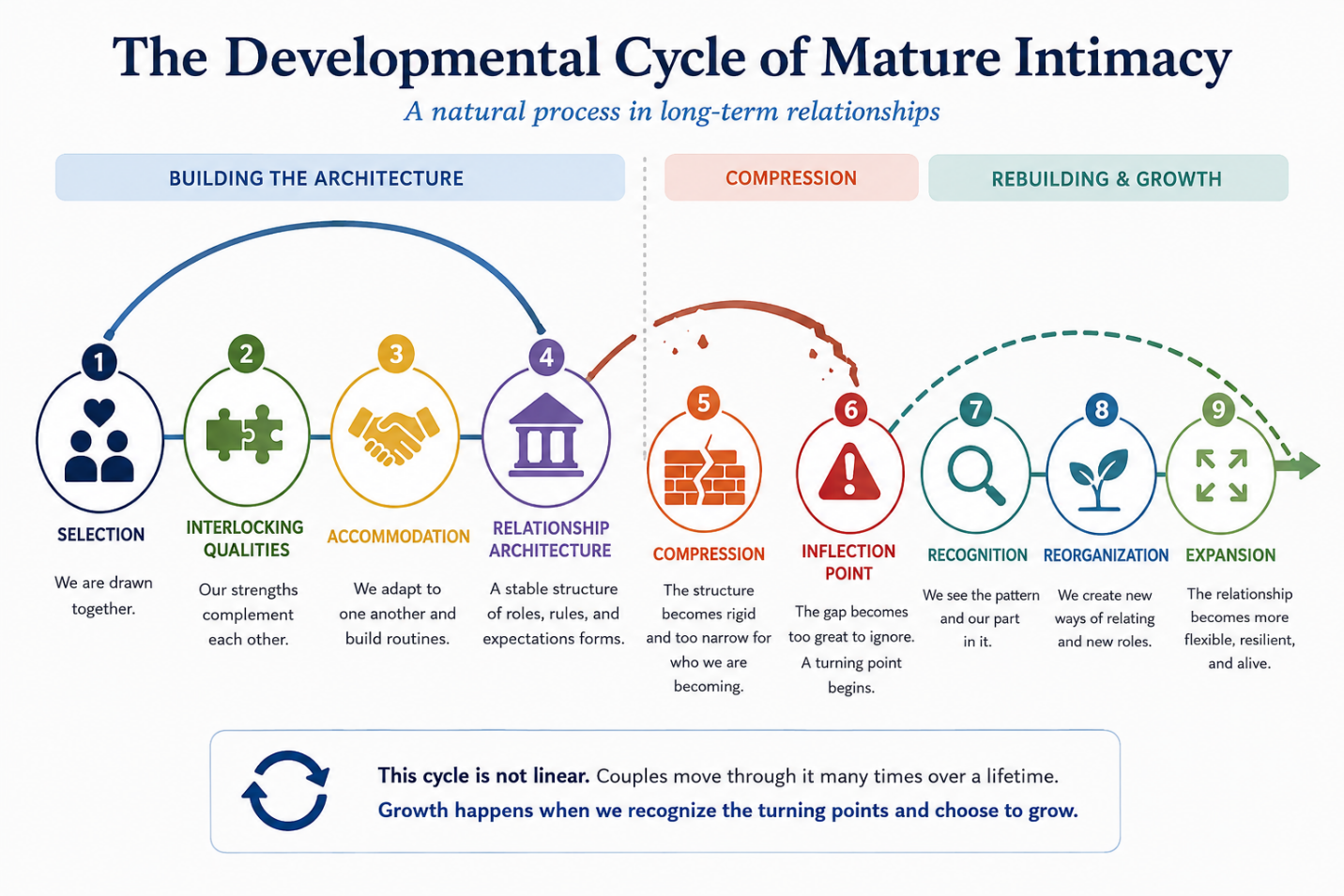
The sequence matters. A relationship does not reach an inflection point simply because time has passed. Rather, its architecture gradually becomes more compressed as the developmental realities of the people within it exceed what its established roles, assumptions, and patterns can comfortably accommodate. Compression is therefore the process that generates the pressure from which inflection emerges.
At the inflection point, the relationship faces a developmental choice. The partners may devote increasing psychological energy to preserving the existing architecture, often resulting in greater rigidity, repetitive conflict, exhaustion, or emotional distance. Alternatively, the impasse may create an opening for Recognition: the capacity to step outside the familiar pattern enough to see the organization itself rather than experiencing each partner as simply being the problem.
From there, Recognition can make Reorganization possible. New roles, expectations, capacities, and ways of relating can gradually emerge, allowing the relationship to become more flexible and developmentally responsive. This movement toward Expansion does not represent a final destination, however. A reorganized relationship eventually stabilizes into a new architecture, and that architecture may itself encounter developmental limits as life continues.
For that reason, the Inflection Model is best understood as recursive rather than linear. Mature intimacy does not consist of constructing one ideal relationship and preserving it indefinitely. It consists, in part, of developing the capacity to recognize when an existing form has become too narrow and to participate together in creating the next one.
A Couple at an Inflection Point
The following vignette is a composite constructed from recurring clinical themes. Details have been combined and altered so that it does not describe an identifiable patient or couple.
A couple I will call Anna and Michael entered therapy because of parenting. Their arguments had become relentless following the birth of their second child. Anna described Michael as controlling: he corrected routines, worried excessively about schedules, questioned her decisions, and seemed unable to tolerate anything being done differently from the way he thought best. Michael experienced Anna as impulsive and insufficiently responsible. He believed that if he did not anticipate problems, organize the household, and maintain consistency, things would fall apart.
Each had considerable evidence for the other’s alleged deficiency. But the parenting conflict had a history.
Early in their relationship, Michael’s competence had been one of the qualities Anna most admired. He planned trips, handled practical problems, managed finances, and created a stability that felt deeply reassuring. Anna brought spontaneity, emotional expressiveness, playfulness, and flexibility into Michael’s highly organized world. He felt more alive with her; she felt safer with him.
Their differences had interlocked beautifully.
Without consciously choosing it, however, those qualities gradually became reciprocal roles. Michael increasingly carried structure; Anna increasingly represented flexibility. He anticipated; she responded. He worried; she reassured. What had originally been difference slowly hardened into identity.
Their first child intensified this arrangement without overwhelming it. With the arrival of the second, the demands on the family increased. Michael responded to greater uncertainty by becoming more organized. Anna responded to his increasing control by resisting him and relinquishing responsibility in domains where she believed she would simply be corrected anyway.
Each person’s solution made the other’s position more extreme.
This is Compression. Michael was no longer merely a man who could be highly organized; he was increasingly required to be the responsible one. Anna was no longer a woman capable of both spontaneity and responsibility; she increasingly occupied the position of the spontaneous one. The available psychological space within the relationship was narrowing.
The second child’s arrival did not create the architecture, nor was it by itself the inflection point. It intensified developmental demands on an already compressed system until the discrepancy could no longer be managed in the old way. Their relentless parenting conflict announced that the relationship had reached inflection.
The initial therapeutic task was therefore not simply to decide whose parenting approach was correct. It was to make the organization visible. Gradually another description became possible. Michael’s competence was not merely control; it had long been one of the ways he managed uncertainty and cared for those he loved. Anna’s flexibility was not simply irresponsibility; it reflected a capacity to tolerate unpredictability and emotional complexity that Michael had always needed from her.
But neither could remain only that person.
Reorganization required Anna to develop forms of responsibility that were genuinely her own rather than performed under Michael’s supervision. Michael had to tolerate the anxiety of allowing another competent adult to do things differently. Anna needed to discover that autonomy was not achieved primarily by resisting Michael, while Michael needed to discover that relinquishing control was not equivalent to abandoning his family.
The parenting disagreements did not disappear. What changed was the architecture through which they were experienced. As the roles became less compulsory, disagreements were less likely to confirm each partner’s worst understanding of the other. Michael could sometimes be uncertain; Anna could sometimes provide structure. The relationship had more psychological positions available to it.
The change was larger than solving the parenting problem. The relationship became larger than the organization that had produced it.
Recognition: Seeing the Relationship Beneath the Conflict
Most couples begin therapy focused quite reasonably on one another: What is wrong with him? Why does she keep doing this? Why won’t he understand? Why is nothing ever enough for her? Therapy can become trapped at this level as well, with the therapist inadvertently becoming an arbiter of whose interpretation is more accurate or whose communication is more skillful.
Many longstanding relational patterns become more understandable only when the focus widens. The question becomes not merely, What does each partner do? but What kind of relationship do these two ways of being continually create together?
I call this shift Recognition.
Recognition occurs when something that previously felt like reality begins to be experienced as an organization. Benjamin’s (1995) work on recognition is relevant here: intimacy requires increasingly encountering the other as a separate center of experience rather than only as the person occupying a familiar position in one’s psychological world.
Recognition does not mean pretending that every problem is equally co-created. Relationships are not morally symmetrical, and responsibility is not always evenly distributed. What Recognition does is restore complexity.
The responsible partner may begin seeing not only how much responsibility they carry, but how completely carrying it has organized the other person into the complementary position. The withdrawing partner may recognize that distance is not simply an immutable personality characteristic but one side of a relational system in which the other person has increasingly assumed responsibility for emotional engagement.
The couple begins to distinguish the person from the position that person has come to occupy within the relationship. What had seemed fixed begins to acquire a history, and what has a history becomes somewhat less likely to be mistaken for destiny.
What Couples Therapy Can Do Differently
Research offers good reason for confidence in couples therapy. A major meta-analysis found substantial improvements in relationship satisfaction as well as meaningful gains in communication, emotional intimacy, and partner behavior following couple therapy (Roddy et al., 2020). Reviews of contemporary couple therapy similarly suggest that several established approaches are effective while leaving important questions about mechanisms of change and the durability of gains (Lebow & Snyder, 2022).
The Inflection Model is not intended to replace these approaches. It changes the level at which I sometimes begin to listen.
The presenting problem matters. If a couple is arguing about parenting, the parenting disagreement needs to be understood. If trust has been damaged, the injury requires attention. If sexuality has disappeared from the relationship, that absence should not simply be converted into a symbol for something else. But I am also listening for the relationship beneath the conflict.
How did these two people become organized around one another? What adaptive qualities did each bring into the relationship? How did those qualities initially fit? What roles gradually emerged? What assumptions about intimacy, responsibility, dependence, vulnerability, conflict, or autonomy became so familiar that they ceased to feel like assumptions? Where has the architecture compressed? What possibilities have become unavailable, and what has each person become required to be?
These questions move therapy away from repeatedly litigating the argument of the week and toward understanding the organization that makes so many different arguments feel strangely alike.
Mapping the Work of Therapy
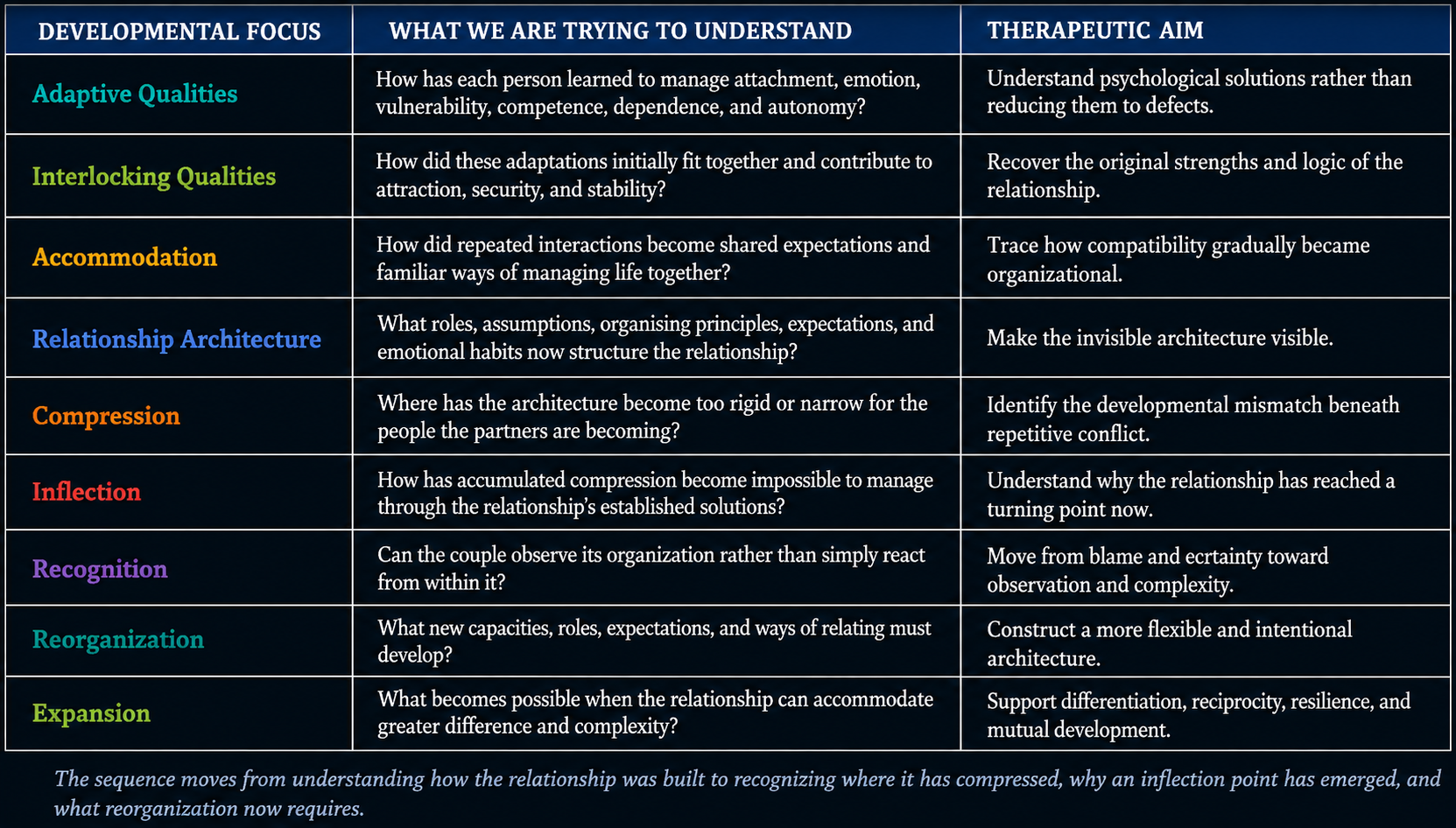
The distinction I find particularly important is between restoration and reorganization. Couples understandably want to get back to how things used to be, and some aspects of an earlier relationship may indeed deserve recovery: tenderness, curiosity, playfulness, sexuality, generosity, or shared purpose.
But psychologically, it is often impossible—and perhaps undesirable—to return fully to an earlier organization. Life has occurred, and the people have been changed by it. The task may therefore not be to repair the old structure sufficiently for everyone to resume their former positions, but to discover what kind of relationship can now contain people who are no longer precisely who they were when that structure was built.
From Mutual Adaptation to Mutual Development
Early compatibility often depends upon a form of mutual adaptation: Your established way of being works with mine. This is not a lesser form of love. It can provide remarkable security and intimacy, and we often need first to be met by someone with whom we can remain recognizably ourselves.
But over a lifetime, intimacy may ask for something beyond confirmation. At some point, the partner who once allowed us to remain organized in familiar ways may become the person in whose presence those ways no longer suffice. This can initially feel like betrayal: You used to accept me.
Perhaps they did. But mature love may involve another kind of acceptance—becoming interested not only in who the other person has reliably been, but in who that person is becoming.
The movement I am describing is from mutual adaptation toward mutual development. The relationship is no longer valuable only because it allows two people to remain psychologically coherent. It also becomes one of the places in which each encounters capacities that familiar adaptations had previously made unnecessary.
The caretaker may have to receive. The self-sufficient person may have to depend. The certain person may have to tolerate not knowing. The conflict-avoiding person may have to discover that disagreement does not necessarily destroy connection.
Such development cannot simply be prescribed because adaptations endure for reasons. The therapeutic work is not to strip them away, but to understand what they once protected, what they still accomplish, and whether additional ways of being can develop so that the adaptation becomes less compulsory.
In this sense, Reorganization does not repudiate the old relationship. It incorporates it into something larger.
Expansion: A Relationship Large Enough for Two Developing People
I use the word Expansion for what can follow successful reorganization. Expansion does not mean permanent harmony. A mature relationship is not one in which conflict disappears, all needs are met, or two people eventually become perfectly attuned.
It may look less dramatic. Partners become somewhat less certain that they already know each other. Roles become less compulsory. Difference can exist without immediately becoming evidence of rejection. A person can behave outside the identity the relationship has assigned them without destabilizing the entire system. The responsible one can need help; the quiet one can have something important to say; the dependent one can become more autonomous; the strong one can become frightened.
The familiar person becomes, in small ways, unfamiliar again. That unfamiliarity is not necessarily a failure of intimacy; perhaps it is one of intimacy’s conditions. To recognize another person fully is to accept that they remain partly beyond the version of them we have constructed through years of shared life.
Expansion therefore does not mean that the relationship becomes unlimited. It means that its architecture becomes sufficiently flexible to accommodate a greater range of psychological experience. The relationship has more room, and with that additional room comes the possibility of mutual development: a relationship that not only accommodates who each person already is, but helps make possible who each is still becoming.
Eventually, even a successfully reorganized relationship develops patterns. New expectations emerge and a new architecture stabilizes. Life continues. This is why the Inflection Model is cyclical. The goal is not to construct a relationship that will never again experience Compression. The deeper developmental achievement is to become increasingly able to recognize Compression as it occurs and approach subsequent inflection points with greater curiosity, flexibility, and capacity for reorganization.
The Relationship Beneath the Conflict
Some conflicts can and should be solved directly. Couples sometimes need clearer agreements, changed behavior, greater accountability, better communication, or practical compromise.
But there are other conflicts whose persistence suggests that something more is being asked. When the same dilemma survives every attempted solution, it may be worth becoming curious about what the conflict is organizing, what it protects, and what developmental change it may be resisting or announcing.
The question is no longer simply whether the couple can finally settle the argument. It is whether they can become sufficiently interested in the relationship beneath the conflict to discover why their old solutions no longer work.
Over time, I have come to think that this may be one of the deeper purposes of couples therapy: not to persuade two people to remain together, not to teach an ideal form of intimacy, and not simply to restore what has been lost, but to help them see more clearly the relationship they have created and the psychological lives that relationship has made possible.
Sometimes what appears to be the end of an earlier form of intimacy is precisely that: an earlier form is ending. But an ending of form does not necessarily mean an ending of relationship. An inflection point may be the moment when two people face a difficult question—whether they can relinquish enough of the relationship they already know to discover the relationship they have not yet learned how to create.
Perhaps mature intimacy is not finally the capacity to preserve a relationship unchanged through time, but the capacity to allow the relationship to remain alive enough to become different.
Frequently Asked Questions
What is an inflection point in a relationship?
An inflection point is a period when a couple’s established way of relating no longer adequately accommodates what one or both partners need or are becoming. It may become visible through recurring conflict, emotional distance, changes in sexuality, parenting difficulties, betrayal, illness, loss, or simply a growing sense that the relationship cannot continue in quite the same way. The visible problem may be important, but it may also signal a deeper developmental transition within the relationship.
Does reaching an inflection point mean a relationship is failing?
Not necessarily. An inflection point can certainly accompany serious relationship problems, but it can also occur because a relationship that once worked well has become too rigid for changing circumstances or changing people. The crisis may indicate that an earlier form of the relationship has reached its limits rather than that the relationship itself must end.
What is “relationship architecture”?
Relationship architecture refers to the often-unspoken organization that develops between partners over time: roles, expectations, emotional habits, assumptions, divisions of responsibility, and characteristic ways of managing closeness, conflict, vulnerability, and dependence. Much of this architecture develops naturally and can provide stability. Difficulties arise when it becomes so fixed that the people within the relationship have too little room to change.
What does “Compression” mean?
Compression describes the gradual narrowing of possibilities within a relationship. Partners increasingly become identified with familiar roles—the responsible one, the emotional one, the controlling one, the dependent one, the strong one, the withdrawing one—and begin responding to one another through those established expectations. The relationship may still function, but each person has less psychological room to behave differently or develop beyond the role they have come to occupy.
Can qualities that originally attracted partners to each other later become sources of conflict?
Yes. One premise of the Inflection Model is that some differences between partners initially fit together remarkably well. A highly organized person may be attracted to someone’s spontaneity; a self-sufficient person may appreciate a partner who does not demand extensive emotional disclosure. Over time, however, complementary qualities can harden into compulsory roles. What initially created compatibility can then become part of the work the relationship needs to undertake.
Why do some couples keep having the same argument even when the subject changes?
Sometimes recurring arguments are maintained by an underlying relational pattern rather than by the particular issue being discussed. Parenting, money, sex, household responsibilities, or extended family may become different settings in which the same positions repeatedly emerge. In these situations, resolving the immediate disagreement may help, but understanding the relationship organization that repeatedly recreates the conflict may be equally important.
What is the difference between repairing a relationship and reorganizing it?
Repair generally involves restoring something that has been damaged or lost. Reorganization asks a somewhat different question: whether the relationship itself needs to change. Couples may understandably want to “get back to how we used to be,” but sometimes the people involved are no longer precisely who they were when that earlier relationship was created. Therapy may then involve developing new roles, expectations, and ways of relating rather than simply restoring the old ones.
What does “Recognition” mean in the Inflection Model?
Recognition involves becoming able to see the relational pattern itself rather than experiencing one’s partner simply as the problem. Partners begin distinguishing the person in front of them from the role that person has gradually come to occupy within the relationship. This does not mean that responsibility is always equal or that harmful behavior should be excused. Rather, Recognition restores complexity and creates the possibility of responding differently.
What does a healthier relationship look like after an inflection point?
The Inflection Model describes the possibility of Expansion. Expansion does not mean permanent harmony or the disappearance of conflict. It means that the relationship becomes flexible enough to accommodate a wider range of experience. Roles become less compulsory, differences become less threatening, and each partner has greater freedom to behave outside the identity the relationship has historically assigned them.
Can couples therapy help at an inflection point?
Couples therapy can provide a setting in which partners examine both the immediate problems bringing them to treatment and the relationship patterns beneath those problems. The aim is not necessarily to preserve the relationship exactly as it has been. In some cases, the deeper work is helping two people understand what they have created together, what that organization once made possible, where it has become constraining, and whether a more flexible relationship can emerge.
Disclaimer
The clinical observations and examples discussed in this article are drawn from themes that commonly emerge in psychotherapy and from the author’s broader clinical experience. They are not intended to describe any particular patient, couple, or course of treatment. Where clinical situations are referenced, identifying details have been omitted, altered, or combined in order to protect confidentiality. Any resemblance to a specific individual or couple should not be understood as a description of an actual patient or therapeutic relationship.
This article is intended for educational and informational purposes and should not be considered a substitute for psychotherapy, psychological assessment, or other individualized professional care.
About James Tobin, Ph.D.
James Tobin, Ph.D., is a licensed clinical psychologist in private practice in Irvine, California. His work with adults and couples is informed by contemporary psychodynamic and relational psychoanalysis, attachment theory, developmental psychology, systems thinking, and contemporary relationship research. His clinical interests include the ways individuals and relationships become organized around adaptive patterns that once served important psychological functions, and how psychotherapy can make those patterns more visible, flexible, and open to further development.
References
Aron, A., Lewandowski, G. W., Jr., Mashek, D., & Aron, E. N. (2013). The self-expansion model of motivation and cognition in close relationships. In J. A. Simpson & L. Campbell (Eds.), The Oxford handbook of close relationships (pp. 90–115). Oxford University Press.
Benjamin, J. (1995). Like subjects, love objects: Essays on recognition and sexual difference. Yale University Press.
Bowlby, J. (1988). A secure base: Parent-child attachment and healthy human development. Basic Books.
Bühler, J. L., Krauss, S., & Orth, U. (2021). Development of relationship satisfaction across the life span: A systematic review and meta-analysis. Psychological Bulletin, 147(10), 1012–1053.
Dicks, H. V. (1963). Object relations theory and marital studies. British Journal of Medical Psychology, 36(2), 125–129.
Dicks, H. V. (1967). Marital tensions: Clinical studies towards a psychological theory of interaction. Routledge & Kegan Paul.
Doherty, W. J., Harris, S. M., Hall, E. L., & Hubbard, A. K. (2021). How long do people wait before seeking couples therapy? A research note. Journal of Marital and Family Therapy, 47(4), 882–890.
Doss, B. D., Atkins, D. C., & Christensen, A. (2003). Who’s dragging their feet? Husbands and wives seeking marital therapy. Journal of Marital and Family Therapy, 29(2), 165–177.
Johnson, S. M. (2019). Attachment theory in practice: Emotionally focused therapy (EFT) with individuals, couples, and families. Guilford Press.
Karney, B. R., & Bradbury, T. N. (1995). The longitudinal course of marital quality and stability: A review of theory, method, and research. Psychological Bulletin, 118(1), 3–34.
Lebow, J. L., & Snyder, D. K. (2022). Couple therapy in the 2020s: Current status and emerging developments. Family Process, 61(4), 1359–1385.
Minuchin, S. (1974). Families and family therapy. Harvard University Press.
Mitchell, S. A. (1988). Relational concepts in psychoanalysis: An integration. Harvard University Press.
Nielsen, A. C. (2019). Projective identification in couples. Journal of the American Psychoanalytic Association, 67(4), 593–624.
Overall, N. C., & McNulty, J. K. (2017). What type of communication during conflict is beneficial for intimate relationships? Current Opinion in Psychology, 13, 1–5.
Roddy, M. K., Walsh, L. M., Rothman, K., Hatch, S. G., & Doss, B. D. (2020). Meta-analysis of couple therapy: Effects across outcomes, designs, timeframes, and other moderators. Journal of Consulting and Clinical Psychology, 88(7), 583–596.
Scharff, J. S., & Scharff, D. E. (1997). Object relations couple therapy. American Journal of Psychotherapy, 51(2), 141–173.

0 Comments