
Dr. James Tobin Ph.D. - Psychologist
The Four Modes of Relational Parenting
The Four Modes of Relational Parenting
A Developmental and Relational Approach to Parenting Adolescents and Young Adults
Part I: Beyond Behavioral Parenting
Parents rarely seek psychotherapy because they wish to become better developmental psychologists. They seek help because something has gone wrong. Their adolescent refuses to attend school. Their college-aged daughter cannot make decisions without reassurance. Their son withdraws into video games, cannabis, or isolation. Arguments have become relentless. Communication has deteriorated. The family feels trapped in repetitive cycles of conflict, avoidance, disappointment, and fear.
In these moments, parents understandably search for techniques. They ask how to motivate, set consequences, reduce anxiety, establish boundaries, improve communication, or encourage independence. Many contemporary parenting models respond by offering increasingly sophisticated behavioral strategies. These approaches often prove helpful, particularly when children are young or when specific behavioral problems require structure and consistency. Yet therapists who work extensively with adolescents and emerging adults soon discover that techniques alone rarely produce lasting developmental change.
The reason is straightforward. Most parenting difficulties are not fundamentally problems of behavior. They are problems of development.
By adolescence, the central task of parenting is no longer simply helping children behave appropriately. It is helping them gradually construct the psychological capacities required for adulthood. Parents are no longer shaping compliance as much as they are participating in the formation of identity, emotional regulation, reflective functioning, autonomy, responsibility, and mature relationships. Behavior remains important, but behavior becomes meaningful only when understood within the developmental processes it expresses.
This distinction fundamentally changes the therapist’s task. Rather than asking whether parents are enforcing sufficient consequences or communicating effectively, we begin asking a different set of questions. What psychological capacity is currently developing? Which developmental task has become disrupted? What does this young person need from the relationship at this particular moment? How might the parent’s response either facilitate or unintentionally interfere with that developmental process?
These questions shift parenting from a behavioral enterprise to a relational and developmental one.
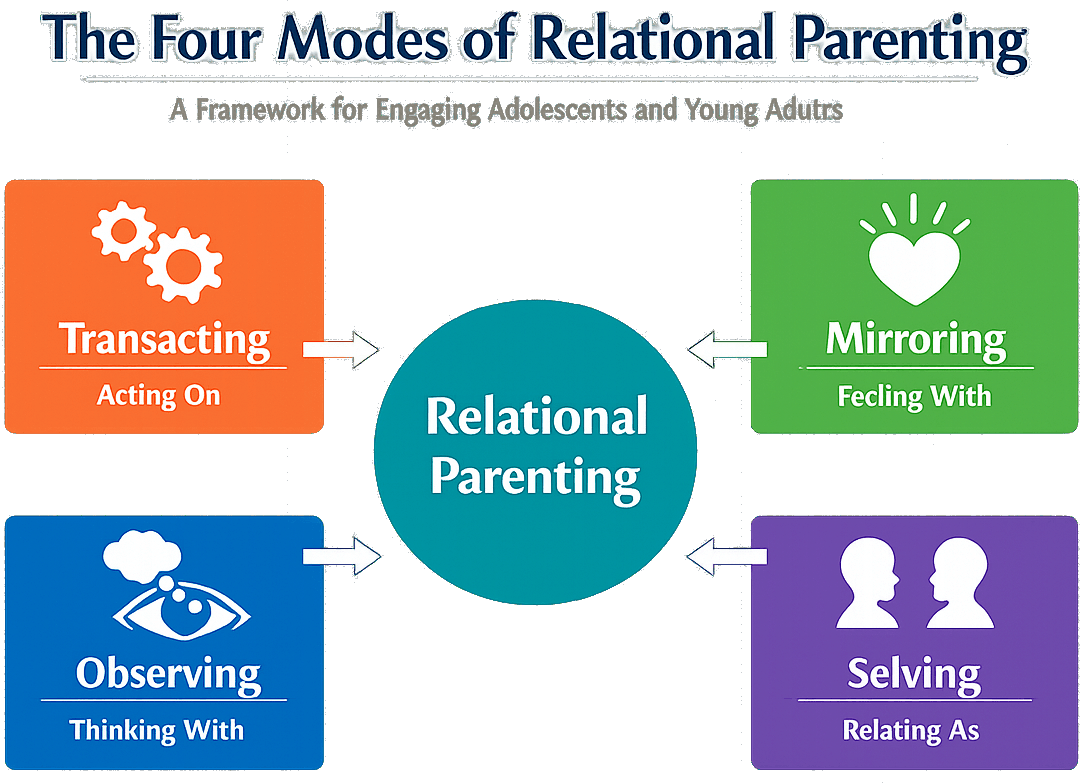
The Four Modes of Relational Parenting (see the Appendix) emerged from this clinical perspective. Rather than viewing parenting as a fixed collection of techniques, the model proposes that effective parenting requires continuous movement among four distinct relational positions. Each position serves different developmental functions. Each cultivates different psychological capacities. Each becomes useful under particular conditions and potentially harmful when overused or applied indiscriminately.
The central clinical task therefore becomes one of flexibility. Effective parents are not those who master one ideal parenting style. They are those who learn to recognize which mode their child requires at a particular developmental moment and who can shift fluidly as those needs evolve.
This emphasis on flexibility distinguishes the model from many traditional parenting frameworks. Parents often ask whether they should be more empathic or more firm, more validating or more challenging, more emotionally available or more independence-promoting. The Four Modes suggests that these questions are incomplete. The more useful question is, “What developmental function does my child most need from me right now?”
The answer changes continuously.
Parenting as Developmental Scaffolding
Developmental psychologists have long emphasized that children do not acquire emotional and psychological capacities in isolation. Human development unfolds within relationships that gradually organize experience into increasingly coherent forms of selfhood.
Attachment theory first demonstrated that sensitive caregiving allows children to develop internal working models of safety, trust, and emotional regulation (Bowlby, 1969, 1988). Winnicott (1965) described the “good-enough mother” not as someone who perfectly satisfies every need but as someone who gradually adapts her responses to the child’s increasing developmental capacities. Bion (1962) emphasized the caregiver’s capacity to contain overwhelming emotional experiences until the child can eventually metabolize them independently. Kohut (1971) viewed empathic responsiveness as essential for the development of a cohesive sense of self. Fonagy and colleagues (2002) later demonstrated that children’s capacity to understand minds—their own and those of others—emerges through repeated experiences of being accurately understood by caregivers.
Although these theories differ substantially, they share a common assumption: psychological capacities first exist between people before they become internal capacities within the individual.
- Emotional regulation initially occurs through co-regulation.
- Reflection first develops through another person’s curiosity.
- Self-esteem grows through repeated experiences of being accurately recognized.
- Identity develops through countless interactions in which children discover who they are in relation to significant others.
The parent’s task, therefore, is not simply to solve problems. It is to provide the developmental experiences through which these capacities become internalized.
This process resembles what Vygotsky (1978) described as scaffolding. Effective scaffolding provides enough support to accomplish tasks that cannot yet be performed independently while simultaneously withdrawing assistance as competence increases. Excessive support prevents autonomy from developing. Insufficient support produces discouragement and failure. Development occurs within this dynamic balance.
Parenting operates similarly. Every parental intervention implicitly communicates assumptions about what the child can currently manage alone and where relational support remains necessary. Successful parenting therefore requires continuous recalibration as development unfolds.
Unfortunately, moments of family stress often reduce this flexibility. Anxiety narrows perception. Parents begin responding primarily to behavior rather than to developmental needs. A withdrawn adolescent elicits increasing attempts at engagement. An anxious young adult receives growing reassurance. An angry teenager encounters escalating control. Parents understandably intensify precisely those interventions that once worked earlier in development.
Yet development continually changes the meaning of parental behavior.
The intervention that fosters growth at age eight may inhibit growth at age eighteen. Reassurance that effectively regulates anxiety in childhood may unintentionally prevent emotional self-regulation during early adulthood. Protective involvement may gradually become intrusive. Structure may become control. Validation may become accommodation. Conversely, expectations for independence introduced too early may overwhelm rather than strengthen emerging capacities.
Therapists therefore benefit from viewing parenting not as a stable set of skills but as an evolving developmental partnership.
From Behavior to Capacity
One of the most important shifts this model asks therapists to make is distinguishing immediate behavior from the psychological capacities that behavior represents.
Parents naturally focus on what children are doing. They see procrastination, avoidance, lying, emotional outbursts, dependence, defiance, withdrawal, perfectionism, or impulsivity. These behaviors understandably become the targets of intervention.
Developmental thinking asks a different question: What capacity has not yet fully developed?
The adolescent who repeatedly seeks reassurance may not primarily require more reassurance or less reassurance. Rather, they may be struggling to develop internal affect regulation. The college student who cannot tolerate ordinary setbacks may not primarily lack motivation. They may lack confidence in their capacity to recover from disappointment. The young adult who repeatedly returns home after interpersonal conflict may not simply be avoiding responsibility. They may never have developed sufficient confidence in their ability to navigate relational distress independently.
When therapists shift attention from behavior to developmental capacity, parent consultation changes dramatically.
Rather than instructing parents simply to modify behavior, we help them create relational experiences that gradually cultivate the underlying capacities from which healthier behavior naturally emerges.
This developmental orientation forms the foundation of the Four Modes of Relational Parenting. Each mode contributes something distinct to psychological growth. None is sufficient by itself. Together they provide a flexible framework through which therapists can help parents think developmentally rather than reactively.
In the sections that follow, we will examine each of these four modes in detail, exploring not only what parents do within each mode, but the psychological functions each serves, the developmental capacities each strengthens, the clinical situations in which each becomes most valuable, and the common ways parents inadvertently become overreliant on one mode at the expense of the others.
Part II: The Four Modes of Relational Parenting
Why Four Modes?
One of the most common questions parents ask is deceptively simple: What should I do?
Should I be more understanding or more demanding? Should I offer reassurance or encourage independence? Should I set firmer limits or become more emotionally available? Should I solve the problem or allow my child to struggle?
Parents often assume that one of these responses must be correct and that effective parenting consists of discovering the right strategy and applying it consistently. Much of the parenting literature unintentionally reinforces this expectation by promoting particular parenting styles or techniques as generally superior. The implicit message is that successful parents become increasingly proficient at doing one thing well.
Clinical experience suggests otherwise.
Families rarely become stuck because parents lack a specific technique. More often, they become stuck because they continue using a response that was once adaptive but no longer matches the developmental needs of their child. The problem is not that the intervention is inherently wrong. It is that it has become developmentally mismatched.
A father who consistently rescues his anxious daughter may have been providing exactly the protection she required during childhood. Years later, those same efforts may unintentionally communicate that she cannot tolerate uncertainty on her own. Parents who continue solving problems for an emerging adult may inadvertently delay the development of confidence, initiative, and self-efficacy. Conversely, parents who insist upon independence before sufficient emotional capacities have developed may overwhelm rather than strengthen their child.
The effectiveness of any parental response therefore depends less upon the behavior itself than upon its developmental timing.
The Four Modes of Relational Parenting emerged from repeated observation that parents who successfully navigate adolescence and young adulthood possess a remarkable ability to shift their relational stance. They do not respond automatically. They first ask themselves, consciously or intuitively, what developmental function is required in this particular moment. They recognize that children require different kinds of relationships at different stages of development, and they understand that growth often depends upon the parent’s willingness to change before expecting the child to change.
This flexibility becomes the hallmark of mature parenting.
Rather than viewing parenting as a fixed style, the Four Modes conceptualizes it as a dynamic repertoire of relational positions. Each mode represents a distinct psychological function. Each contributes something essential to healthy development. None is sufficient by itself.
The therapist’s task is not to teach parents one preferred mode, but to help them develop the flexibility to move among all four with increasing intentionality.
The Four Modes as Developmental Functions
The four modes may initially appear to describe different parenting behaviors. In reality, they represent different developmental purposes.
Transacting helps children function within the external world. Here, parents establish structure, expectations, routines, limits, responsibilities, and consequences. The emphasis is on behavior because behavior is often the most immediate pathway through which children learn self-discipline, responsibility, and social competence.
Mirroring helps children understand themselves emotionally. Parents communicate that inner experience can be recognized, named, understood, and tolerated. Rather than focusing primarily upon what children have done, the emphasis shifts toward understanding what they are feeling and what those feelings reveal about their developing inner world.
Observing creates psychological space for reflection. Instead of immediately correcting, rescuing, or interpreting, parents cultivate curiosity. They encourage children to think about themselves, their relationships, and their choices. Observation strengthens the child’s emerging capacity for self-reflection and mentalization by allowing thoughts and emotions to become objects of contemplation rather than immediate reactions.
Selving supports differentiation and autonomy. Parents increasingly relate to their adolescent or emerging adult as a separate psychological person whose values, preferences, goals, and decisions must gradually become self-authored. Selving does not withdraw support; rather, it transforms the relationship from one of management to one of consultation.
Although each mode emphasizes different developmental tasks, all four ultimately contribute to a common objective: the gradual transfer of psychological functioning from parent to child.
- Parents initially regulate behavior.
- Later they help regulate emotion.
- Eventually they foster reflection.
- Finally, they support independent self-direction.
Healthy development consists of progressively internalizing capacities that were once provided externally through the parent-child relationship.
The Modes Build Upon One Another
It is tempting to imagine these four modes as separate categories that parents choose among according to circumstance. A more accurate metaphor is that of a building. Each successive mode rests upon capacities established by the preceding ones.
Children cannot reflect effectively if emotional experience remains overwhelming and unregulated. They cannot develop mature autonomy without first learning to think about themselves accurately. Likewise, behavioral expectations imposed through Transacting become considerably more effective when children feel understood through Mirroring, and Mirroring itself becomes richer when parents have cultivated the capacity simply to observe before reacting.
Development therefore moves toward increasing psychological complexity.
- Parents who rely exclusively upon Transacting often discover that greater control eventually produces greater resistance. Rules alone cannot produce maturity.
- Parents who rely primarily upon Mirroring may create emotionally validating relationships that nevertheless fail to establish responsibility or accountability.
- Parents who remain indefinitely in Observing sometimes become insightful spectators who hesitate to intervene when structure is genuinely needed.
- Parents who emphasize Selving prematurely may mistake independence for emotional readiness, inadvertently placing developmental burdens upon adolescents who still require considerable guidance and containment.
Each mode compensates for the limitations of the others.
Clinical work therefore shifts from asking whether a parent is empathic, structured, reflective, or autonomy-promoting. Instead, therapists ask whether the parent’s responses collectively provide the developmental experiences necessary for continued psychological growth.
The central question becomes one of balance rather than correctness.
Flexibility Rather Than Consistency
Parents frequently hear that they should be consistent. Certainly, consistency in values, safety, reliability, and emotional availability remains essential. Yet consistency should not be confused with rigidity.
Development itself is inherently dynamic. Children’s psychological capacities evolve continuously. Family circumstances change. Stress increases and decreases. Mental health symptoms fluctuate. Adolescents move toward greater independence while still requiring intermittent dependence. Effective parenting therefore requires continual recalibration.
Experienced therapists often notice that successful parents possess a capacity remarkably similar to that required of effective psychotherapists. They remain grounded in enduring principles while allowing their moment-to-moment interventions to shift according to what the relationship requires. They tolerate uncertainty, resist premature certainty, and continually ask themselves what intervention will best promote development rather than simply reduce immediate distress.
This flexibility is especially important during adolescence and emerging adulthood, when developmental progress is rarely linear. Young people often oscillate between periods of impressive independence and moments of striking regression. A college student who manages academic demands with considerable maturity may return home and behave with surprising dependency. An adolescent who demonstrates excellent judgment in one domain may remain emotionally immature in another. Such fluctuations are not signs of failure. They are characteristic of development itself.
Parents who understand this become less reactive. Rather than interpreting temporary regression as evidence that nothing has changed, they recognize it as part of the uneven process through which new capacities become consolidated.
The Four Modes provide a framework for responding to these fluctuations with flexibility rather than frustration. Instead of becoming trapped in repetitive patterns of rescuing, controlling, accommodating, or withdrawing, parents learn to ask a different question:
What developmental experience is my child needing from me at this moment, and which relational mode is most likely to provide it?
This question marks the transition from intuitive parenting to reflective parenting. It also establishes the organizing principle for the chapters that follow, beginning with the first and most concrete of the Four Modes: Transacting, the relational mode through which children begin learning how to function responsibly within the demands of everyday life.
Part III: Mode One — Transacting
Helping Children Function in the World
The word transacting was chosen deliberately. It refers not simply to discipline or behavioral management, but to the countless transactions through which children gradually learn how to function effectively in the social world. Every family contains innumerable expectations, agreements, routines, responsibilities, negotiations, and consequences. Children learn to complete homework, contribute to household responsibilities, manage money, arrive on time, communicate respectfully, fulfill commitments, and tolerate the ordinary frustrations that accompany participation in family and community life.
These exchanges are more than practical necessities. They are developmental experiences through which children begin constructing an internal sense of responsibility, competence, and agency.
Parents often experience these interactions as repetitive and mundane. They remind children to clean their rooms, complete assignments, attend appointments, help with chores, or follow through on commitments. Because these conversations recur so frequently, it is easy to view them merely as behavioral correction. From a developmental perspective, however, they represent something far more significant. Each transaction provides an opportunity for children to internalize the expectations and organizational capacities that eventually become self-discipline.
One of the central paradoxes of development is that external structure gradually becomes internal structure. The child who repeatedly experiences predictable expectations, consistent follow-through, and appropriate accountability slowly develops the capacity to regulate behavior without continual external supervision. What begins as parental organization eventually becomes self-organization.
Transacting therefore addresses a fundamental developmental question:
How does a child become capable of functioning independently within the ordinary demands of adult life?
The answer is not through lectures or punishment alone. It occurs through thousands of everyday interactions in which responsibility is expected, practiced, corrected, and gradually internalized.
Beyond Discipline
Many parents equate Transacting with discipline. While discipline is certainly part of this mode, reducing Transacting to discipline alone misses its broader developmental purpose.
- The goal is not simply obtaining compliance.
- The goal is cultivating competence.
Children who consistently fulfill responsibilities begin to experience themselves differently. They discover that they can tolerate frustration, complete difficult tasks, delay gratification, recover from mistakes, and contribute meaningfully to family life. These experiences gradually strengthen self-confidence because confidence rarely develops from praise alone. It develops through repeated experiences of mastery.
This distinction helps therapists redirect parent consultations. Parents often become preoccupied with obtaining immediate obedience. They understandably ask, “How do I make my child listen?” A more useful developmental question becomes, “What opportunity for competence is this situation providing?”
Consider an adolescent who repeatedly forgets homework. Parents may become increasingly frustrated and begin monitoring assignments, contacting teachers, checking online portals, and reminding their child each evening. Although these efforts temporarily improve performance, they also transfer executive functioning back to the parent.
The developmental objective is different.
Rather than asking how parents can better manage homework, therapists might ask how responsibility can gradually become the adolescent’s own. This often involves allowing manageable failures to occur while maintaining confidence that the young person possesses the capacity to learn from those experiences. Parents continue providing structure, but they resist assuming responsibility for developmental tasks that increasingly belong to the child.
In this sense, Transacting requires therapists to distinguish support from substitution. Helpful parenting assists children in performing tasks they are learning to master. Unhelpful parenting gradually begins performing those tasks for them.
Structure Creates Freedom
One of the most common misconceptions surrounding structure is that it restricts freedom. Developmental psychology suggests precisely the opposite.
Appropriate structure creates the conditions under which genuine autonomy becomes possible.
Children who learn to organize time, manage responsibilities, tolerate delayed gratification, and recover from mistakes possess greater freedom because they have developed the capacities necessary for independent functioning. Conversely, children who remain dependent upon external reminders, repeated rescue, or continual supervision often experience increasing limitations as adult responsibilities accumulate.
Therapists frequently encounter parents who hesitate to establish expectations because they fear appearing controlling. Others move to the opposite extreme, attempting to manage every detail of their child’s life in an effort to prevent failure. Both approaches misunderstand the developmental purpose of structure.
Healthy structure is not primarily about control. It is about education.
Parents temporarily provide organizational capacities that children have not yet fully developed. As competence increases, responsibility gradually shifts from parent to child. Structure therefore diminishes rather than expands over time.
This developmental progression resembles the gradual removal of scaffolding from a building. The scaffolding exists not because the structure is weak, but because it is still under construction. Once the building becomes self-supporting, the scaffolding is no longer necessary.
The same principle applies to parenting. External organization should decrease as internal organization increases.
Natural Consequences and the Development of Agency
Perhaps no aspect of Transacting generates more anxiety for parents than allowing children to experience the consequences of their own decisions.
Parents naturally wish to protect their children from disappointment, embarrassment, academic setbacks, financial mistakes, interpersonal failures, and emotional pain. Yet excessive protection often deprives children of one of development’s most powerful teachers: reality itself.
- Natural consequences differ fundamentally from punishment.
- Punishment is imposed by another person.
- Natural consequences emerge from the ordinary structure of life.
The student who neglects to study performs poorly on an examination. The young adult who overspends discovers that discretionary income has disappeared. The teenager who repeatedly forgets athletic equipment eventually sits on the bench. These experiences are not failures of parenting. They are developmental opportunities through which children begin recognizing the relationship between choices and outcomes.
Therapists often help parents tolerate the considerable anxiety that accompanies allowing these experiences to unfold. Parents understandably fear that one setback will permanently damage motivation or self-esteem. More commonly, however, manageable failures strengthen resilience by teaching children that mistakes can be survived, understood, and corrected.
The therapist’s role is therefore twofold. First, to help parents distinguish between consequences that are developmentally useful and those that are genuinely dangerous. Second, to help parents remain emotionally available without prematurely rescuing children from every experience of frustration.
Children require both security and reality.
Too much security without reality produces dependence.
Too much reality without security produces despair.
Healthy Transacting maintains both simultaneously.
Common Clinical Pitfalls
Therapists quickly discover that parents rarely underuse Transacting intentionally. More often, they become trapped in predictable patterns that undermine its developmental purpose.
Some parents rescue repeatedly. They complete forgotten assignments, negotiate with teachers, replace lost possessions, wake adolescents who ignore alarms, or solve interpersonal conflicts before children have attempted to do so themselves. Although motivated by love, these interventions gradually communicate a troubling message: You cannot manage this without me.
Other parents become increasingly controlling. Frustrated by repeated failures, they monitor every activity, issue continual reminders, and tighten supervision in the hope of producing responsibility. Ironically, the more responsibility parents assume, the less opportunity children have to develop it themselves. Control often becomes self-perpetuating.
Still others confuse accountability with criticism. Conversations become dominated by disappointment, frustration, and repeated evaluations of performance. Over time, children begin associating responsibility not with competence but with shame. Rather than becoming more engaged, they withdraw, avoid, or conceal mistakes to protect themselves from anticipated criticism.
In each of these situations, the therapist redirects attention from immediate behavior to developmental process. The question is not simply whether the child completed the task. The deeper question is whether the interaction strengthened or weakened the child’s emerging sense of agency.
Clinical Illustration
Consider a seventeen-year-old who repeatedly forgets school assignments. His parents have become increasingly involved. They monitor online grade portals several times each day, remind him about deadlines, email teachers regarding missing work, and frequently remain awake late into the evening helping him complete overdue assignments.
From the parents’ perspective, these interventions demonstrate commitment. From the adolescent’s perspective, however, the organizational responsibility remains located almost entirely within the parental relationship.
During consultation, the therapist reframes the problem. Rather than asking how the parents can become more effective managers, the conversation shifts toward how the adolescent can gradually become the primary manager of his own academic life. Together, they identify responsibilities the parents can intentionally relinquish while maintaining emotional encouragement and reasonable expectations. The initial result is not immediate improvement. Grades temporarily decline, and both parents experience understandable anxiety.
Several months later, however, the young man begins using a planner independently, contacts teachers himself, and experiences genuine satisfaction in completing assignments without parental prompting. The behavioral gains are important, but the deeper developmental achievement lies elsewhere. Responsibility has moved from the relationship into the self.
This is the ultimate purpose of Transacting. Parents begin by managing behavior. Over time, they help children become capable of managing themselves.
Part IV: Mode Two — Mirroring
Helping Children Discover Their Inner World
If Transacting teaches children how to function within the external world, Mirroring helps them understand the internal world they carry within them. Human beings are not born with the capacity to recognize, organize, and regulate their emotional lives. These capacities emerge gradually through repeated interactions with caregivers who respond not only to behavior but to the subjective experience that gives rise to behavior.
Every parent has experienced moments in which a child’s outward actions conceal a more complicated inner reality. An angry adolescent may be frightened. A defiant child may be ashamed. A withdrawn young adult may be grieving. An apparently unmotivated college student may feel profoundly overwhelmed by fear of failure. Behavior alone rarely reveals the psychological meaning of an experience.
Mirroring begins with the assumption that development requires more than behavioral correction. Children must also come to recognize their own thoughts, feelings, wishes, conflicts, and vulnerabilities. They need caregivers who can wonder about their experience rather than simply react to it.
This capacity develops relationally. Long before children can identify their own emotions, another person identifies them first. Parents notice distress, excitement, disappointment, curiosity, pride, embarrassment, loneliness, and fear. Through thousands of these interactions, children gradually acquire language for internal experience. Eventually, what was first understood by another becomes something they can understand within themselves.
Mirroring therefore answers a second developmental question:
How do children gradually become capable of understanding themselves?
The answer is not through explanation alone. It occurs through repeatedly experiencing another mind attempting to know their own.
The Child Who Feels Seen
Perhaps the simplest way to understand Mirroring is through the experience of feeling genuinely seen.
Most people can recall relationships in which someone seemed to understand them before they fully understood themselves. Such experiences often leave a lasting psychological impression because they reduce one of the deepest anxieties of human development: the fear that our inner lives are unknowable or incomprehensible.
Children require this experience repeatedly.
- A frightened child who hears, “That really surprised you,” begins to associate bodily sensations with recognizable emotion.
- An adolescent who hears, “I wonder if you felt left out more than angry,” begins discovering that feelings often exist beneath reactions.
- A young adult who hears, “Part of you wants independence, and another part feels frightened about leaving home,” begins appreciating the complexity of internal conflict.
Notice that none of these responses solve the problem. They organize experience.
Parents often believe they are helping primarily by offering reassurance, advice, or solutions. While these responses may occasionally be useful, they sometimes interrupt a more important developmental process. Children frequently need to feel understood before they need to be instructed. When understanding consistently precedes advice, children become increasingly capable of reflecting upon themselves rather than merely reacting.
Mirroring therefore communicates a powerful developmental message:
Your inner experience is understandable.
That message becomes the foundation upon which emotional regulation and self-reflection gradually develop.
Mirroring and the Development of the Self
The psychoanalytic tradition has long emphasized that our earliest sense of self develops within relationships. Winnicott described how caregivers gradually help infants feel psychologically real by responding sensitively to emerging needs. Kohut later proposed that empathic responsiveness allows children to experience themselves as coherent, valued, and emotionally integrated. Contemporary attachment and mentalization research has extended these ideas by demonstrating that caregivers who accurately perceive and reflect children’s internal states foster increasingly sophisticated capacities for emotional awareness and self-understanding.
Although these theoretical traditions employ different language, they converge upon a common principle: children come to know themselves through being known.
Mirroring should therefore be understood as a developmental process rather than simply an empathic communication skill. Parents are not merely validating feelings. They are helping children construct an internal vocabulary through which future emotional life can be organized.
Consider the adolescent who repeatedly experiences criticism whenever disappointment appears. Over time, sadness may become transformed into anger because anger feels safer than vulnerability. Another child whose anxiety is repeatedly dismissed may eventually lose confidence in his own emotional perceptions. Still another whose parents become overwhelmed by every emotional expression may learn that feelings themselves are dangerous.
In each instance, development has been shaped not simply by the emotion itself, but by the relational response that followed.
Mirroring alters that trajectory.
When parents consistently demonstrate curiosity about subjective experience, children gradually become curious about themselves. Emotional awareness becomes less threatening because internal life has repeatedly been met with interest rather than avoidance, criticism, or alarm.
Curiosity Before Certainty
One of the most important skills therapists teach parents is the discipline of curiosity.
Parents understandably become convinced they know why their children behave as they do. They assume laziness, manipulation, entitlement, disrespect, anxiety, depression, immaturity, or defiance. Occasionally these interpretations are accurate. More often, however, they become fixed narratives that narrow perception.
Mirroring asks parents to replace premature certainty with thoughtful curiosity.
- Instead of declaring, “You’re just being lazy,” a parent might wonder, “I notice you’ve had difficulty getting started lately. I wonder what’s been happening inside when you sit down to work.”
- Instead of insisting, “You’re overreacting,” the parent becomes interested in understanding what the experience has felt like.
This distinction appears subtle but carries profound developmental implications. Curiosity communicates that the child’s internal world deserves investigation.
Certainty prematurely closes that investigation.
Therapists quickly discover that curiosity often reduces defensiveness more effectively than confrontation. Adolescents who instinctively resist correction frequently respond differently when they experience authentic interest in their perspective. They become collaborators in understanding rather than defendants required to justify themselves.
Curiosity also protects parents from one of the greatest hazards of caregiving: confusing behavior with character. Rather than concluding that a child is irresponsible, selfish, dramatic, or unmotivated, curiosity maintains openness to the possibility that behavior expresses developmental struggles not yet fully understood.
Mirroring Is Not Agreement
Parents often worry that understanding feelings will undermine accountability. They fear that empathy communicates approval or excuses problematic behavior. This concern is understandable but rests upon a misunderstanding of Mirroring.
Understanding experience is not equivalent to endorsing behavior.
- A parent may fully appreciate an adolescent’s humiliation after being excluded by friends while still maintaining clear expectations regarding respectful behavior at home.
- A therapist may understand why an emerging adult avoided an important conversation while simultaneously encouraging greater responsibility.
Mirroring concerns the person’s subjective experience, not the moral evaluation of subsequent actions.
Indeed, children who feel accurately understood often become more receptive to accountability because they no longer experience correction as evidence that their emotional reality has been ignored. Once the internal experience has been recognized, conversations about behavior become considerably easier.
This sequencing matters.
Parents frequently reverse the order. They begin by correcting behavior and only later attempt empathy if the interaction deteriorates. Mirroring suggests the opposite approach. By first communicating understanding, parents establish the emotional safety necessary for more productive conversations about responsibility.
For therapists, this becomes an important consultation principle:
Understanding usually precedes influence.
Children rarely become more reflective when they feel fundamentally misunderstood.
Common Clinical Pitfalls
Mirroring, like every developmental mode, can become distorted when overused or misunderstood.
Some parents confuse Mirroring with endless emotional processing. Every feeling becomes the subject of extended discussion, while expectations and limits gradually disappear. Children may become highly articulate about emotions yet struggle to tolerate frustration or assume responsibility. Reflection becomes detached from action.
Other parents unintentionally shift attention toward themselves. A child’s distress evokes the parent’s own anxiety, guilt, or need to reassure. The conversation subtly becomes organized around helping the parent feel less uncomfortable rather than helping the child understand the experience. Although well-intentioned, this reversal limits the child’s opportunity for genuine self-exploration.
Still others rush too quickly toward reassurance. An anxious adolescent hears, “Everything will be fine,” before anyone has explored what the anxiety actually feels like. A disappointed child is immediately reminded to “look on the bright side.” While intended to comfort, premature reassurance can inadvertently communicate that difficult emotions should be escaped rather than understood.
The therapist’s role is to help parents slow the interaction. Before changing the feeling, become interested in it. Before solving the problem, understand how the child is experiencing the problem. Development often accelerates when conversations move more slowly.
Clinical Illustration
A sixteen-year-old girl returns home visibly upset after an argument with close friends. Her parents immediately attempt to reassure her, suggesting that friendships change, that the situation will likely resolve itself, and that she should simply focus on school rather than “drama.” Feeling dismissed, she retreats to her bedroom and refuses further conversation.
During consultation, the therapist helps the parents consider a different response. Instead of immediately reducing the distress, they begin by acknowledging it.
“You seem really hurt. I wonder if this felt like more than just an argument.”
After a long silence, she begins describing fears of rejection that neither parent realized had been growing for months. The discussion gradually broadens into concerns about belonging, identity, and self-worth. Only much later do they consider possible solutions.
Nothing about the external problem has immediately changed. Something far more important has.
The young woman has experienced her emotional life as worthy of attention rather than something to be corrected or minimized. In doing so, she has taken another step toward developing the capacity to understand and regulate herself.
Mirroring allows children to discover that their inner world can be known. In the next section, Observing, the developmental task changes again. Once children begin recognizing their internal experience, they gradually become capable of examining it with increasing distance, curiosity, and reflection.
The central question now becomes:
How do children move from experiencing their thoughts and feelings to thinking about their thoughts and feelings?
That shift marks one of the most important transitions in psychological development and introduces the third mode of relational parenting.
Part V: Mode Three — Observing
Helping Children Develop a Reflective Mind
One of the most remarkable achievements of psychological development is the gradual emergence of an observing mind. Young children experience thoughts, feelings, and impulses as immediate realities. They become angry, frightened, disappointed, or excited, and these experiences are often indistinguishable from the self. Emotion is not something they have; it is something they become.
As development proceeds, however, an extraordinary psychological capacity begins to emerge. Individuals gradually become able to step back from immediate experience and examine it with curiosity. Rather than being overwhelmed by anger, they can notice themselves becoming angry. Rather than acting immediately upon anxiety, they can wonder what the anxiety is communicating. Thoughts become objects of reflection rather than unquestioned facts.
This developmental transition fundamentally changes how people relate to themselves.
Observing therefore answers another essential developmental question:
How do children become capable of thinking about their own experience rather than simply living inside it?
The answer lies not primarily in insight or intelligence, but in repeated relationships that encourage reflection over reaction.
From Immediate Reaction to Reflection
Many parent-child interactions become organized around urgency. A problem appears, and everyone moves quickly toward solving it. An adolescent receives a disappointing grade, and parents immediately begin discussing study habits. A college student experiences conflict with a roommate, and parents start offering solutions. A young adult becomes anxious about an upcoming interview, and family members rush to provide reassurance.
Although understandable, these responses often bypass a critical developmental opportunity.
Before children learn how to solve problems, they benefit from learning how to think about problems.
Observing deliberately slows this process.
Rather than asking, “What should we do?” parents begin with different questions.
“What do you make of what happened?”
“What do you notice about your reaction?”
“Has something like this happened before?”
“What do you think made this situation so difficult?”
These questions are not designed to delay action unnecessarily. Rather, they cultivate an increasingly sophisticated capacity for self-reflection. Children begin noticing patterns rather than isolated events. They discover recurring emotional themes. They recognize the influence of expectations, assumptions, relationships, and previous experiences.
Gradually, they become students of their own minds.
The Parent as an Observer Rather Than a Manager
One of the most significant shifts parents make during adolescence involves changing from manager to observer.
During childhood, parents appropriately organize much of the child’s experience. They establish schedules, solve practical problems, anticipate difficulties, and intervene frequently. As children mature, however, continual management becomes increasingly incompatible with healthy development.
Parents must gradually relinquish the role of primary problem solver. This transition often proves surprisingly difficult.
Many parents equate helping with doing. They believe that remaining actively involved demonstrates love, responsibility, and commitment. Yet development increasingly asks something different of them. Rather than directing every situation, they must become capable of accompanying their children while allowing them to think, struggle, experiment, and learn.
Observing therefore requires considerable parental restraint. Parents learn to tolerate unanswered questions. They resist filling every silence. They postpone immediate advice. They become curious before becoming instructive.
For many families, this slowing down initially feels uncomfortable. Parents worry that inaction communicates indifference. Adolescents sometimes become frustrated because they expect immediate solutions. Yet over time, something important begins to change.
The child starts generating more of the thinking.
Instead of borrowing the parent’s mind, the child increasingly uses his or her own.
The Development of Mentalization
Contemporary developmental research has emphasized the importance of what Peter Fonagy and colleagues describe as mentalization—the capacity to understand behavior in terms of underlying thoughts, feelings, intentions, wishes, and beliefs. Individuals who mentalize effectively recognize that both they and other people possess complex inner worlds that cannot be reduced to outward behavior alone.
Observing provides fertile ground for this capacity.
Parents no longer interpret situations solely through actions and consequences. Instead, they become interested in the invisible psychological processes shaping those actions.
Consider an adolescent who abruptly withdraws from family activities. One parent may conclude that the teenager has become selfish or disrespectful. Another may immediately assume depression. An observing parent remains open to multiple possibilities.
“I’ve noticed you’ve been spending much more time alone recently. I’m wondering what that’s been like for you.”
This response communicates several important developmental messages.
- First, behavior is worthy of thoughtful inquiry rather than immediate judgment.
- Second, people are psychologically complex.
- Third, understanding often requires curiosity before conclusion.
Repeated experiences of this kind gradually teach children to approach both themselves and others with greater psychological sophistication.
This capacity extends far beyond family life. It becomes central to mature friendships, intimate relationships, leadership, psychotherapy, parenting, and virtually every context in which understanding another person’s perspective matters.
Learning Through Experience Rather Than Protection
Observing also changes how parents think about mistakes.
Parents naturally hope to prevent unnecessary suffering. They intervene to reduce disappointment, protect confidence, and avoid failure whenever possible. While these intentions are deeply understandable, excessive intervention can unintentionally deprive children of opportunities for reflection.
Mistakes become psychologically valuable not because failure itself is desirable, but because reflection transforms experience into learning.
When parents immediately rescue children from every setback, the experience often ends before reflection begins. Observing asks parents to remain emotionally present while allowing children sufficient space to examine what occurred.
Following a disappointing examination, the conversation might sound very different.
Rather than saying, “You need to study harder next time,” the parent asks, “What do you think happened?”
Rather than insisting upon immediate solutions, the parent wonders, “Looking back now, what would you do differently?”
The goal is not self-criticism. The goal is self-understanding.
Over time, children begin conducting these conversations internally. Reflection gradually becomes self-reflection. The observing parent eventually becomes the observing self.
Tolerating Uncertainty
Perhaps no quality distinguishes reflective parenting more than the capacity to tolerate uncertainty.
Parents often feel intense pressure to know exactly what is happening, why it is happening, and what should be done next. Yet human development rarely unfolds with such clarity. Adolescents change rapidly. Motivations remain mixed. Symptoms evolve. Relationships become increasingly complicated.
Parents who prematurely seek certainty sometimes close off developmental exploration. Observing encourages a different stance.
Instead of rushing toward definitive explanations, parents learn to remain thoughtfully uncertain.
“I’m not entirely sure what’s happening here yet.”
“Let’s stay curious a little longer.”
“I wonder if there are several things contributing.”
This tolerance for ambiguity communicates confidence rather than helplessness. Children discover that uncertainty need not produce panic. Complex problems often require sustained reflection before solutions emerge.
In psychotherapy, we recognize that insight rarely arrives through force. It develops gradually as experience is examined from multiple perspectives. Families benefit from the same process.
Common Clinical Pitfalls
Parents often misunderstand Observing in predictable ways.
Some mistake observation for passivity. Conversations become thoughtful but action never follows. Problems are endlessly discussed while necessary boundaries, expectations, or interventions are postponed. Reflection becomes an excuse for avoidance.
Others intellectualize emotional experience. Every feeling receives sophisticated analysis while genuine emotional engagement quietly disappears. Children may become highly articulate about psychology yet remain disconnected from lived experience.
Still others confuse observation with surveillance. Rather than cultivating curiosity, they scrutinize every behavior, searching for evidence of pathology or failure. Adolescents understandably experience such observation as intrusive rather than supportive.
Healthy Observing differs from each of these distortions. It remains emotionally engaged. It leads naturally toward thoughtful action. And it communicates trust rather than suspicion.
Clinical Illustration
A nineteen-year-old college student returns home after changing majors for the second time. His parents immediately become anxious. They fear he lacks direction and begin proposing career assessments, alternative universities, and conversations with extended family members.
During consultation, the therapist encourages a different approach.
Rather than organizing the next decision immediately, the parents become interested in the developmental process unfolding beneath the decision.
Over several conversations, they ask what attracted him to each field, what disappointed him, what he has discovered about himself, and what he notices across these repeated changes. Initially frustrated by the absence of advice, the young man gradually begins articulating themes that had remained outside awareness. He recognizes that many of his academic choices have been organized more by fear of disappointing others than by genuine interest.
This realization becomes the turning point. No parent could have given him that insight directly. It emerged because the relationship created enough psychological space for reflection to occur.
The parents’ greatest contribution was not providing the answer. It was helping their son develop the capacity to discover it himself.
Observing represents a profound developmental shift. Children are no longer simply learning to behave responsibly or to recognize their emotions. They are learning to become reflective participants in their own psychological lives.
Yet one developmental task still remains.
A young person may function responsibly, understand emotions, and think reflectively while still remaining psychologically organized around parental expectations. The final developmental movement requires something even more challenging: becoming a separate person while preserving connection.
This is the task of the fourth and final mode of relational parenting—Selving—through which parents gradually relinquish the role of primary author of their child’s life and become trusted companions in the child’s ongoing construction of an authentic adult identity.
Part VI: Mode Four — Selving
Helping Children Become Themselves
Every successful act of parenting contains a paradox: Parents devote years to becoming indispensable to their children while simultaneously preparing themselves to become progressively less necessary.
This gradual relinquishment is neither abandonment nor emotional withdrawal. Rather, it represents one of the deepest developmental tasks of family life. Parents slowly shift from directing the child’s life to respecting the emergence of another independent mind. Their role changes from manager to consultant, from instructor to collaborator, from primary decision-maker to trusted attachment figure.
This developmental transition is what I describe as Selving.
Selving refers to the ongoing process through which children become authors of their own lives. They begin making decisions based not primarily upon parental approval or fear of disapproval, but upon increasingly integrated values, preferences, judgments, and aspirations that genuinely belong to them.
The task is not rebellion. Nor is it obedience. The task is authorship.
Children who successfully navigate this transition discover that they can remain deeply connected to those they love without surrendering the capacity to think, choose, and live as distinct individuals.
Selving therefore answers the final developmental question:
How do children become separate adults without losing the relationships that helped create them?
Differentiation Rather Than Detachment
Parents frequently misunderstand independence.
Some imagine that healthy adulthood requires emotional distance. Others fear that encouraging independence will inevitably weaken family relationships. Both assumptions reflect a false choice between closeness and autonomy.
Family systems theorists, particularly Murray Bowen, argued that psychological maturity is better understood as differentiation. Differentiated individuals remain emotionally connected while maintaining the capacity to think independently under relational pressure. They neither fuse with others nor isolate from them. They remain themselves in the presence of important relationships.
Selving seeks precisely this balance.
- A differentiated young adult can disagree with parents without feeling compelled to sever contact.
- He can disappoint others without collapsing into guilt.
- She can seek advice without surrendering responsibility for the final decision.
- Parents likewise become capable of offering guidance without requiring compliance.
The relationship changes from one organized around authority to one organized around mutual respect. This transformation rarely occurs suddenly. It develops gradually through hundreds of interactions in which parents increasingly communicate a powerful message:
“Your life belongs to you.”
From Directing to Consulting
One of the most noticeable shifts during Selving involves the parent’s use of authority.
Earlier in development, parents appropriately make many decisions on behalf of their children. They determine schedules, educational expectations, safety rules, financial limits, medical care, and countless other aspects of daily life. Their authority provides stability while children develop the capacities required for independent judgment.
As adolescence progresses, however, the developmental function of authority changes.
- Parents increasingly become consultants rather than directors.
- Consultation differs fundamentally from instruction.
- Instruction assumes responsibility remains primarily with the parent.
- Consultation assumes responsibility is gradually moving toward the child.
This distinction becomes evident in ordinary conversations.
Instead of saying,
“Here’s what you need to do.”
Parents increasingly ask,
“Would it be helpful if I told you what I’m thinking?”
Instead of insisting upon agreement, they offer perspective while respecting the young person’s right to decide. This shift communicates extraordinary confidence.
Parents implicitly say,
“I believe you are becoming capable of making increasingly important decisions. My role is no longer to control every outcome but to remain available as you continue developing your own judgment.”
Many emerging adults report that this change significantly strengthens the parent-child relationship. They seek advice more freely because they no longer experience advice as disguised control.
Respecting Psychological Otherness
Perhaps the greatest challenge of Selving is accepting that children eventually become psychologically different from their parents.
Every parent carries conscious and unconscious hopes regarding the child’s future. These hopes often arise from love, sacrifice, personal values, cultural traditions, family expectations, and unfinished dreams. Most are entirely understandable.
Development eventually requires something difficult.
Parents must increasingly distinguish between their own life and their child’s life.
- A daughter may choose a profession her parents never imagined.
- A son may reject long-held family traditions.
- An emerging adult may adopt different political beliefs, religious convictions, lifestyles, or priorities.
These differences frequently generate anxiety because they challenge longstanding parental assumptions about success, identity, and belonging.
Selving asks parents to tolerate this difference without interpreting it as rejection.
Children become adults not by perfectly reproducing parental identities but by constructing identities that are authentically their own.
Parents remain influential. They simply cease being the final authority regarding who their children become.
The Parent’s Developmental Task
One of the most overlooked aspects of parenting is that children are not the only people developing. Parents develop as well.
Every developmental achievement in the child requires a corresponding developmental adjustment in the parent.
As children become increasingly independent, parents must tolerate new forms of uncertainty.
- They must relinquish control while remaining emotionally invested.
- They must witness mistakes they can no longer prevent.
- They must watch children make choices they would not make themselves.
Perhaps most importantly, they must grieve the gradual disappearance of earlier relationships that can never fully return.
Many parents experience these transitions privately. The child leaving for college. The first holiday spent elsewhere. The first serious romantic relationship. Marriage. Grandchildren. Each milestone quietly reorganizes the emotional structure of the family.
Healthy Selving recognizes these losses without allowing grief to interfere with the child’s continued development.
Parents who successfully navigate this transition often discover something unexpected. Their relationship with their adult children becomes richer, not because authority has increased, but because mutual recognition has.
Common Clinical Pitfalls
Parents often struggle with Selving in predictable ways.
- Some continue parenting adult children as though they remain adolescents.
- They offer unsolicited advice.
- Monitor decisions.
- Intervene in ordinary difficulties.
- Attempt to prevent disappointment before it occurs.
Although motivated by love, these behaviors often communicate limited confidence in the young person’s developing capacities.
- Other parents respond in the opposite direction. Believing adulthood requires complete independence, they withdraw emotionally just when their children continue needing a secure attachment relationship.
Young adults rarely require less connection. They require connection organized differently.
A third pattern involves conditional autonomy.
- Parents verbally encourage independence while subtly rewarding decisions that align with parental expectations and discouraging those that do not.
Children quickly perceive this inconsistency. The apparent freedom remains psychologically constrained because acceptance depends upon agreement.
Therapeutic work often involves helping parents recognize these subtle dynamics. The developmental objective is not agreement. It is relationship that can tolerate disagreement.
Clinical Illustration
A twenty-four-year-old woman informs her parents that she intends to leave a stable corporate position to pursue graduate training in an entirely different field. Her parents become deeply concerned. They worry about financial security, educational debt, and occupational uncertainty. Their first impulse is to persuade her to reconsider.
During consultation, the therapist encourages the parents to distinguish between their anxiety and their daughter’s developmental task.
Over several weeks they begin shifting from persuasion toward consultation. They ask thoughtful questions about her reasoning, encourage careful planning, discuss practical concerns honestly, and offer their experience without insisting upon compliance.
Eventually she chooses to proceed with graduate school. The parents continue feeling anxious. But something important has changed.
Their daughter experiences them not as obstacles to overcome but as trusted companions whose perspective remains valuable even when she ultimately chooses differently.
The relationship survives precisely because individuality has been respected.
Selving and the Completion of Parenting
The ultimate purpose of parenting has never been perpetual dependence. Nor has it been premature independence.
Its purpose has always been the gradual construction of a person capable of living thoughtfully, responsibly, and authentically while sustaining meaningful relationships throughout life.
Selving represents the culmination of that developmental journey. Children become adults who can think for themselves without rejecting those who taught them to think.
They can choose differently without withdrawing emotionally. They can remain connected without surrendering themselves.
For parents, this may be the deepest expression of love. Not producing a child who remains close because he cannot leave. Nor producing one who leaves because closeness feels impossible.
But helping create an adult who returns—not from obligation, fear, or dependence—but because the relationship itself has become a place where individuality and connection can peacefully coexist.
Part VII: Clinical Integration
Thinking Developmentally Rather Than Reactively
The Four Modes of Relational Parenting are not intended to function as a sequence of techniques or a checklist of parenting skills. Rather, they offer therapists a developmental framework for understanding what parents are being asked to provide at different moments in their child’s psychological growth.
Most parent consultations begin with behavior. Parents describe arguments, anxiety, avoidance, emotional outbursts, declining academic performance, excessive gaming, substance use, conflict with peers, or difficulty launching into adulthood. These concerns are real and deserve careful attention. Yet behavior alone rarely identifies the developmental task.
The therapist’s first responsibility is to look beneath the presenting symptom.
Instead of asking, “How do we stop this behavior?” the clinician asks a different question:
“What psychological capacity appears to be developing—or has become stalled—and what does this young person need from the parent in order for that capacity to continue developing?”
This question immediately changes the consultation. Parents begin seeing behavior as communication rather than merely as misconduct. Symptoms become invitations to understand development rather than simply problems to eliminate.
The Four Modes provide four possible developmental responses.
- If the young person lacks organization, responsibility, or follow-through, Transacting may need strengthening.
- If emotional experience has become confusing or overwhelming, Mirroring may be required.
- If the child reacts impulsively without reflection, Observing may help cultivate mentalization and perspective.
- If development has become constrained by excessive dependence or parental control, Selving may become the primary therapeutic focus.
The therapist therefore does not ask which mode is best. The therapist asks which developmental function is currently missing.
Assessing Parents Through the Four Modes
The Four Modes also provide a useful way of understanding parents themselves.
Parents rarely lack all four capacities. More often, they develop habitual ways of relating that reflect their own histories, personalities, attachment experiences, and sources of anxiety.
Some parents become exceptionally skilled at structure. They establish expectations, routines, and accountability with remarkable consistency. Yet they struggle to recognize emotional experience. Their children often become responsible but emotionally isolated.
Others excel at empathy. They understand feelings intuitively, provide extraordinary emotional support, and cultivate warm relationships. Yet they find it difficult to tolerate conflict, disappointment, or natural consequences. Their children may feel deeply understood while remaining overly dependent.
Still others naturally encourage reflection. Conversations become thoughtful, psychologically sophisticated, and intellectually rich. Yet they hesitate to establish boundaries or intervene decisively when action becomes necessary.
Finally, some parents move comfortably toward autonomy. They encourage independence, respect individuality, and avoid unnecessary control. Yet they may underestimate how much structure or emotional containment remains necessary during periods of stress.
No parent remains perfectly balanced. Indeed, perfection is neither realistic nor desirable. The therapist’s role is not to eliminate parental preferences but to expand parental flexibility.
As parents become increasingly comfortable moving among all four modes, they become capable of responding to development rather than merely reacting to behavior.
Clinical Applications
The Four Modes become particularly useful when working with common clinical presentations because they discourage one-dimensional interventions.
An anxious adolescent, for example, often requires all four modes, though in different proportions. Parents provide enough Transacting to preserve ordinary responsibilities despite anxiety. They offer Mirroring by recognizing the child’s emotional experience without dismissing or catastrophizing it. They encourage Observing by helping the adolescent notice patterns of anxious thinking rather than becoming engulfed by them. Finally, they foster Selving by communicating confidence that the young person can increasingly tolerate uncertainty without continual parental reassurance.
Similarly, adolescents with attention-deficit/hyperactivity disorder often require stronger external organization through Transacting, but structure alone rarely proves sufficient. These young people also benefit from Mirroring, particularly because repeated academic or behavioral failures often generate shame that remains hidden beneath apparent indifference. Observing helps them recognize their own attentional patterns, emotional triggers, and executive functioning challenges with increasing accuracy. Selving encourages gradual ownership of organizational strategies rather than lifelong dependence upon parental management.
Children and adolescents experiencing depression frequently require parents to remain active in Transacting, maintaining routines, school attendance, sleep schedules, and ordinary responsibilities whenever clinically appropriate. At the same time, Mirroring becomes indispensable because depressive withdrawal often conceals profound loneliness, hopelessness, or self-criticism that must first be understood before it can be challenged. Observing helps adolescents recognize depressive thoughts as experiences rather than objective truths, while Selving preserves hope that the depression does not define the emerging adult identity.
The model is equally useful with autism spectrum presentations, substance misuse, chronic family conflict, and so-called “failure to launch.” In each situation the therapist asks the same developmental question: Which psychological capacity requires further support, and which relational mode best facilitates that growth?
Teaching the Four Modes to Parents
Parents frequently experience considerable relief when introduced to this framework.
Many arrive believing that every parenting interaction requires finding the correct answer. They worry constantly about saying the wrong thing, setting the wrong limit, or making the wrong decision.
The Four Modes replace this pressure with developmental curiosity.
Rather than asking, “Am I doing this correctly?” parents begin asking,
“What does my child most need from me right now?”
- This question often transforms family interactions.
- Parents become less reactive.
- They tolerate uncertainty more comfortably.
- They become increasingly capable of adjusting their responses as development unfolds.
Perhaps most importantly, they stop viewing parenting disagreements as contests over who is right. Couples often discover that they have each become identified with particular modes. One partner reliably provides structure while the other naturally offers emotional understanding. Rather than arguing about which approach is superior, they begin appreciating how each contributes different developmental functions. Parent consultation therefore shifts from resolving differences to coordinating complementary strengths.
As therapists, we can facilitate this process by encouraging parents to review difficult interactions through the lens of the Four Modes. After a challenging week, they might ask themselves:
- Which mode did I primarily rely upon?
- Which mode was largely absent?
- Was my response organized around my child’s developmental needs or around my own anxiety?
- Did this interaction strengthen my child’s psychological capacities or simply reduce immediate distress?
- If I could revisit the situation, would I shift into a different mode?
These questions rarely produce immediate perfection. They do cultivate increasingly reflective parenting.
Parenting as the Construction of Psychological Capacities
Although the Four Modes describe different relational positions, they share a common developmental purpose.
- Parents initially provide externally what children cannot yet provide internally.
- They organize behavior until self-discipline develops.
- They recognize emotions until self-awareness develops.
- They encourage reflection until self-reflection develops.
- They support independent decision making until self-authorship develops.
Development therefore involves a gradual transfer of psychological functioning from relationship to person. This understanding has profound implications for clinical work. Rather than viewing dependency as failure, therapists recognize it as the beginning of every developmental achievement.
Rather than interpreting autonomy as separation, they understand it as the successful internalization of capacities that first emerged within secure relationships.
Parenting becomes less about controlling behavior and more about constructing minds.
Conclusion
Parenting adolescents and emerging adults is often described as one of life’s most difficult responsibilities. The challenge arises not because parents care too much, but because development continually changes what children require from them. The response that fostered growth yesterday may unintentionally inhibit growth tomorrow. Love alone does not determine effectiveness. Developmental timing, psychological flexibility, and relational wisdom matter equally.
The Four Modes of Relational Parenting were developed to help therapists and parents navigate this complexity. Rather than prescribing a single parenting style, the model encourages continuous movement among four complementary relational functions: Transacting, Mirroring, Observing, and Selving. Each mode contributes something essential. Each becomes limited when used in isolation. Together they provide a developmental map for helping children become responsible, emotionally aware, reflective, and authentically themselves.
Ultimately, the purpose of parenting is not simply to produce well-behaved children. It is to participate in the gradual construction of adults who can regulate themselves, understand themselves, think for themselves, and live according to values they have made their own while remaining capable of deep and enduring relationships.
When viewed from this perspective, the countless ordinary moments of family life assume extraordinary significance. Conversations at the dinner table, disagreements over homework, emotional disappointments, difficult decisions, and even inevitable conflicts become opportunities for development. Each interaction asks the same fundamental question:
What psychological capacity is trying to emerge here, and how can this relationship help bring it into being?
For therapists, that question provides more than a parenting strategy. It offers a way of thinking about development itself.
References
Ainsworth, M. D. S., Blehar, M. C., Waters, E., & Wall, S. (1978). Patterns of attachment: A psychological study of the strange situation. Erlbaum.
Benjamin, J. (1995). Like subjects, love objects: Essays on recognition and sexual difference. Yale University Press.
Bion, W. R. (1962). Learning from experience. Heinemann.
Bowlby, J. (1969). Attachment and loss: Vol. 1. Attachment. Basic Books.
Bowlby, J. (1973). Attachment and loss: Vol. 2. Separation: Anxiety and anger. Basic Books.
Bowlby, J. (1988). A secure base: Parent-child attachment and healthy human development. Basic Books.
Bowen, M. (1978). Family therapy in clinical practice. Jason Aronson.
Cassidy, J., & Shaver, P. R. (Eds.). (2016). Handbook of attachment: Theory, research, and clinical applications (3rd ed.). Guilford Press.
Fonagy, P., Gergely, G., Jurist, E. L., & Target, M. (2002). Affect regulation, mentalization, and the development of the self. Other Press.
Fosha, D. (2000). The transforming power of affect: A model for accelerated change. Basic Books.
Gottman, J. M., & Declaire, J. (1997). The heart of parenting: Raising an emotionally intelligent child. Simon & Schuster.
Kegan, R. (1994). In over our heads: The mental demands of modern life. Harvard University Press.
Kohut, H. (1971). The analysis of the self. International Universities Press.
Mahler, M. S., Pine, F., & Bergman, A. (1975). The psychological birth of the human infant: Symbiosis and individuation. Basic Books.
Minuchin, S. (1974). Families and family therapy. Harvard University Press.
Perry, B. D., & Winfrey, O. (2021). What happened to you? Conversations on trauma, resilience, and healing. Flatiron Books.
Porges, S. W. (2011). The polyvagal theory: Neurophysiological foundations of emotions, attachment, communication, and self-regulation. W. W. Norton.
Ryan, R. M., & Deci, E. L. (2017). Self-determination theory: Basic psychological needs in motivation, development, and wellness. Guilford Press.
Siegel, D. J. (2012). The developing mind: How relationships and the brain interact to shape who we are (2nd ed.). Guilford Press.
Siegel, D. J., & Bryson, T. P. (2011). The whole-brain child: 12 revolutionary strategies to nurture your child’s developing mind. Delacorte Press.
Sroufe, L. A. (1996). Emotional development: The organization of emotional life in the early years. Cambridge University Press.
Stern, D. N. (1985). The interpersonal world of the infant. Basic Books.
Vygotsky, L. S. (1978). Mind in society: The development of higher psychological processes. Harvard University Press.
Winnicott, D. W. (1960). The theory of the parent-infant relationship. International Journal of Psycho-Analysis, 41, 585–595.
Winnicott, D. W. (1965). The maturational processes and the facilitating environment. International Universities Press.
Learn More About All of Dr. Tobin's Services
Visit Dr. Tobin's Office
2 Venture
Suite 440
Irvine, CA 92618
Hours
Monday: 8am - 8pm
Tuesday: 8am - 8pm
Wednesday: 8am - 8pm
Thursday: 8am - 8pm
Friday: 8am - 8pm
Saturday: Closed
Sunday: Closed

jt@jamestobinphd.com

(949) 338-4388

Schedule Today
Visit Dr. Tobin's Office
2 Venture
Suite 440
Irvine, CA 92618
Hours
Monday: 8am - 8pm
Tuesday: 8am - 8pm
Wednesday: 8am - 8pm
Thursday: 8am - 8pm
Friday: 8am - 8pm
Saturday: Closed
Sunday: Closed
jt@jamestobinphd.com
(949) 338-4388
Schedule Today